
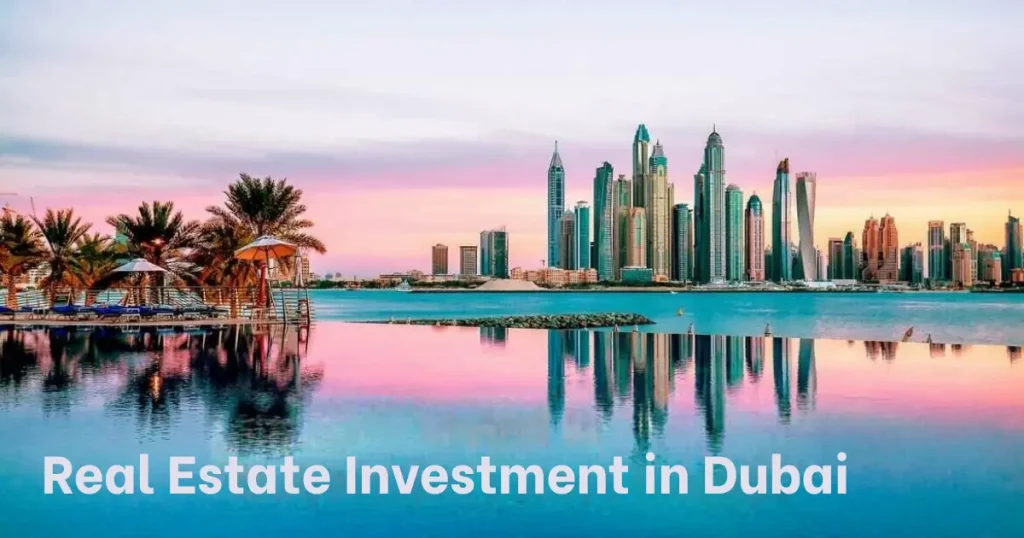

Dubai: Global real estate investment is still led by city, driven by robust GDP growth, smartcity makeover and international appeal, and that city is none other than Dubai. With new infrastructure projects underway, rental yields rising, and new innovative trends that include tokenization and crypto-payments, Dubai is still at the top of the list for investors. For you, Real Estate Investment in Dubai guide gives you everything you need – strategy, timing, finance, legalities, career vision – to capitalize on Dubai property investment in 2025.
Why Invest in Dubai Property?
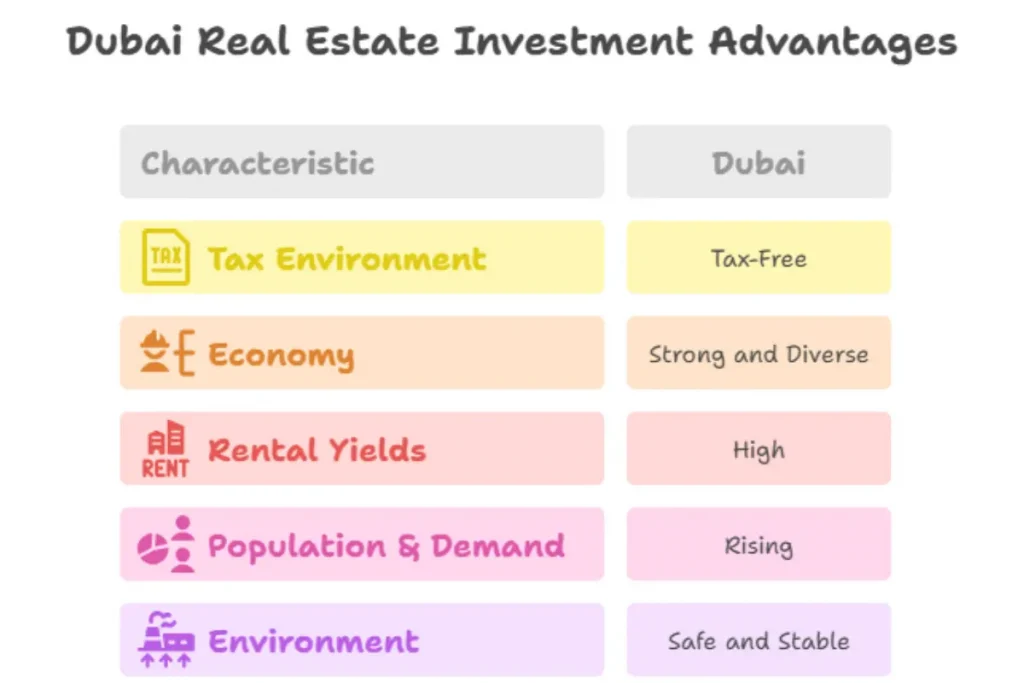
Following are several reasons that make Dubai an excellent investment destination for real estate investors:
Tax-Free Environment
The best benefit of all is Dubai being a tax-free country. There is no income tax, no capital gains tax, and no real property tax imposed on investors and their real estate held. This makes the net returns much higher than on many other investment destinations in the world.
Strong and Diverse Economy: Dubai has a robust diversified economy and has moved away from its dependence on oil. Among other sectors, the tourism, trade, logistics, financial services and technology sectors are all going to contribute massively to GDP growth (expected to reach 4.1% by 2025, according to the World Bank). This financial stability is conducive to an environment of stability and confidence for real estate.
High Rental Yields and Capital Growth
Dubai always provides some of the world’s most attractive rental yields with potential annual returns of 6% to 8%, and sometimes exceeding this depending on the type and location of property. Locations such as Jumeirah Village Circle (JVC), Al Furjan, and Arjan have also reported high rental yields – particularly in studio and 1-bed apartments.
The market has been good not only on rental value but also for capital appreciation with values growing substantially in the last few years.
Rising Population and High Demand
The population of Dubai is continuously expanding with the inflow of new residents and the boom of the expat community (more than 88% of the inhabitants being expats). With the growing need for housing (for long-term and short-term holiday rentals for a booming tourism industry), this keeps the rental market healthy and keeps both rental and sales prices on a steady increase.
Safety, stability, and a world-class environment
As one of the world’s safest cities, Dubai is home to a stable political environment and an effective legal system, which inspires investor confidence. The city is committed to providing its residents and businesses with some of the best infrastructure available in the world, as evident in the fantastic transport networks (including the Dubai Metro Blue Line) and high-quality living standards and opportunities.
Types of Property Investment in Dubai
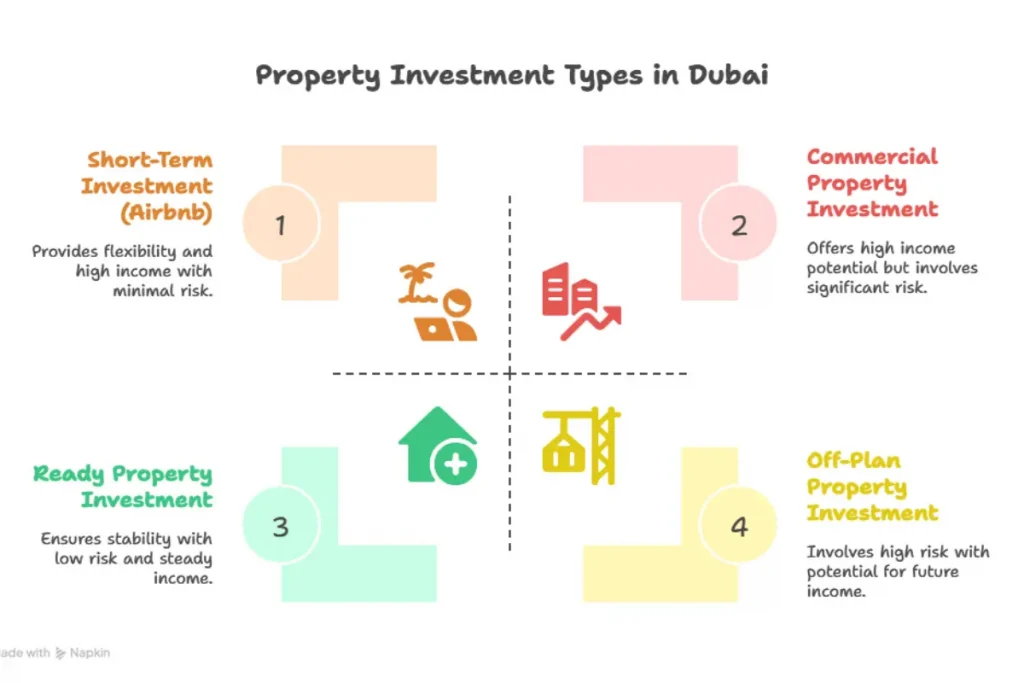
It’s crucial to categorize property investments effectively to guide potential investors. Dubai’s real estate market offers a diverse range of options tailored to different investment goals.
Here are the primary types of property investment in Dubai:
1. Residential Property Investment
This is the most popular kind of investment and you can find the best of both worlds: long-term rental income and the increase in property value over the time.
Apartments: Studio to penthouse apartments are extremely popular, particularly in vibrant locales such as Dubai Marina, Downtown Dubai, Business Bay and Jumeirah Village Circle (JVC). They can make for good rental yields as they have a high demand from both expats and tourists.
Villas & Townhouses: These have a bit more privacy and space which is more appealing to families and those who like a more luxurious lifestyle. Communities such as Arabian Ranches, Emirates Hills, Palm Jumeirah and Tilal Al Ghaf are famed for their villa clusters. They do not come cheap, but they can produce a lot of capital appreciation.
Duplexes and Lofts: These are specialized types of home that offer distinct living spaces, often with high ceilings and open designs.
2. Commercial Property Investment
When investing in a commercial property, you will typically receive higher rental yields than you would with a residential property, although you will usually need more money upfront.
Office Spaces: Smaller units to entire office floors, in business nodes such as Business Bay, Downtown Dubai, and Jumeirah Lake Towers (JLT) are in demand. Demand comes from local and international businesses.
Retail Spaces/Shops: These shops situated in malls, high-street locations, or community centers are designed for the retail industry. High traffic areas are everything.
Warehouses & Industrials: They are available in logistics and industrial areas such as Jebel Ali Free Zone (JAFZA) and Dubai Investments Park (DIP) for businesses particularly those engaged in trading, manufacturing and logistics. They can make for a property that does not need to be micromanaged in the same way as a residential property.
Commercial Buildings: Owning an entire commercial building can earn you money from several tenants (they could be hotels, business centers, office buildings).
Commercial Villas: Residential villas redeveloped or zoned for commercial purposes, such as clinics, nurseries and boutique offices.
3. Off-Plan Property Investment
This means buying into a property even though it doesn’t exist yet — not yet built, or not even begun.
Advantages:
Price:Usually 15-30% cheaper compared to a ready unit and multiple payments options (50/50, 60/40, 1% monthly payments on delivery).
Possibility to Make Capital Gains: The value of the property will raise during and after the construction process, gaining good returns.
Sleek Designs & Services: Many new construction projects have more updated systems, designs, and community amenities.
Considerations:
Developer Reputation: It is very important that you deal with a reputed, RERA-approved developer to avoid delays or cancellation of the project.
No immediate income: Taking possession is the only time rentals immediately begin.
4. Ready Property Investment (Secondary Market)
They are finished and suitable for immediate living or renting.
Advantages:
Fast income: You can earn rent from day one.
Less Risk: You can see the condition of the property and the existing community before you buy to avoid construction delays.
Hard Asset: It’s what you can see that you can touch, giving it transparency.
Considerations:
More Expensive To Buy: Generally costs more than off-plan properties.
Little Customization: there is already a form of design and layout out there.
Aging Infrastructure: May not be equipped with the newest smart home features, unless recently remodeled.
5. Short-Term Investment (Airbnb)
Taking advantage of Dubai’s surging tourism industry, this entails short-term letting (from days to few months).
Advantages
Potentially Greater Income: Can demand premium pricing, particularly in high seasons and popular events.
Flexibility: Homeowners can use the unit themselves when it’s not being rented.
Considerations
Increased Maintenance & Management : Needs regular cleaning, turnover of guests, and management, usually by a professional property management service.Results Ads Pros and Cons Final Thought.
Segments of Fluctuating Income: Income may fluctuate due to seasonal demand and depending on occupancy levels.
Regulation & Licensing: Operators must hold permits from the Department of Economy and Tourism (DET) in Dubai in order to be legally operational.
Best Neighborhoods: Dubai Marina, Downtown Dubai, Palm Jumeirah and Jumeirah Beach Residence are all great spots for a short-term booking.
Top Locations for Real Estate Investment
- Downtown Dubai, Marina, and Palm Jebel Ali are high-end, tourist-driven zones.
- Dubai Hills Estate, Creek Harbour, JVC – Affordable mid-market with rising demand
- Business Bay—a commercial/residential hybrid, with iconic towers like Burj Binghatti Jacob & Co.
- Expo City / Al Quoz – Industrial and logistics play fueled by mega-events and infrastructure
Investment Property Strategy & Timing
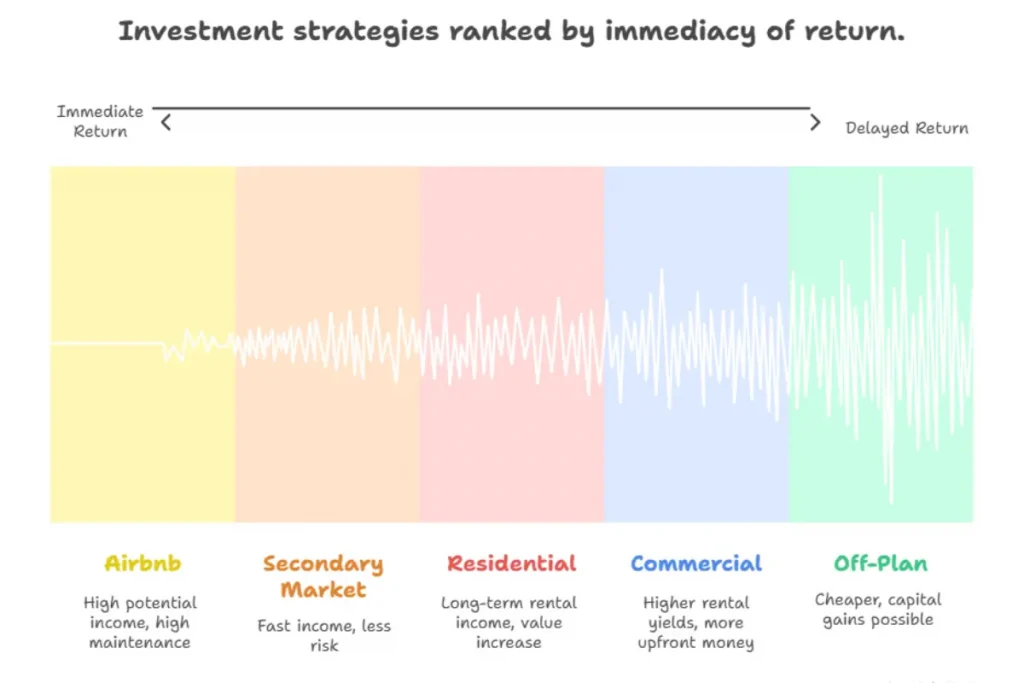
Long-term vision and timing are key words when it comes to Dubai real estate investment. This guide helps you with different investment strategies and important timing factors that you need to be aware of to navigate this ripe market successfully.
Choosing the right strategy depends on your financial goals, risk tolerance, and time horizon. So is the right real estate investment in Dubai for you? Successful real estate investment in Dubai is knowing when it’s the right time to enter—and when it’s not.
Buy-to-Let: This is still a very popular route, providing an opportunity to gain a solid stream of rental payments (‘rental yield’) that historically yields anything from 6% to 10%. This predictable cash flow is a major attraction for many investors.
Holding: This is the preferred strategy with strong pipeline supply and continued infrastructure development in Dubai expected at least until 2026. The end goal and the development plans of the city strongly favour continued capital appreciation.
Value-Add Flipping: “For Developers“ The best time to get into this is during the off-plan phase or during the mid-cycle market dips. Additional Comments It should be pointed out that sources such as Fitch expect a potential softening in prices later in 2025 According to (Winforth, Wikipedia, NOVVI Properties, Reuters); this might offer good opportunities to invest in acquiring overdue value add or flip properties if one is looking to time the market.
Smart Timing: No matter what strategy is selected, clever timing—either the time of a new project launch or dampened market periods—can make a substantial difference in your Return On Investment (ROI).
“You need the right time, and with due consideration of the real estate market and Dubai’s development journey, these strategies become interesting and effective methods of investing in property.”
Financing & Affordability for Funding Your Dubai Home Purchase

Knowing the lay of the land will help any would-be investor make a wise property investment in Dubai. There are several types of financing available in market, each with its pros and cons.
Mortgage Options: For Residents and Expats
You can obtain a broad spectrum of mortgages products from Dubai’s lenders, created to suit both local citizens and even overseas investors.
Loan-to-Value (LTV) Ratios:
Expats Up to 75% LTV Expatriate purchasing can go up to 75% of the value of the property with a minimum 25% deposit. LTVs may drop to as low as 50% for nonresidents.
Up to 80% LTV for Nationals:This is generally offered to the UAE nationals, up to 80% LTV which means they can use finance for up to 80% of the property value with a minimum 20% as a down payment.
Today’s Interest Rates (Mid-2025): Fixed mortgage rates in the UAE are typically between 3.75% and 4.99%, depending on the provider, mortgage term, and borrower qualifications. For certain borrowers, some banks are promoting rates as low as 2.95%–3.15%. Rates in Dubai remain competitive thanks to intense competition among local banks, even if at a premium to global rates. Floating rates derives from the EIBOR (Emirates Interbank Offered Rate).
Front-end Costs: More than the Deposit
It’s important to take into consideration extra upfront costs that go beyond the down payment, which buyers usually have to finance themselves. These may total around 6–8% of the value of the property.
DLD (Dubai Land Department) Fees: A major expense is the 4% transfer fee from the DLD, which typically the buyer pays. There is also an administrative fee of AED 580 for apartments and offices, or AED 430 for land.
Property Registration Fees For properties with a value less than AED 500,000, it is AED 2,000 + 5% VAT. For homes priced above AED 500,000, it’s AED 4,000 + 5% VAT.
Agency Fees: usually 2% of the sales price + 5% VAT.
Registration fees (mortgage or payment schedule): When availing mortgage there is an OUTSIDE DLD charge of 0.25% of the loan amount + AED 290.
Bank Mortgage Fees: Approximately 1% of Accurate interest plus 5% VAT.
Property Valuation Costs: Usually from AED 2,500 to AED 3,500 + 5% VAT.
Conveyancing Fees – For legal and administrative purposes, this may cost you between AED 6,000 to AED 10,000.
Security Deposit: This is usually 10% of the negotiated selling price, payable to the broker.
Other Possible Costs: DEWA (Dubai Electricity and Water Authority) deposits (AED 2,000 for apartments, AED 4,000 for villas), Empower (district cooling) charges, and highly advised though not mandatory, home insurance (approximately AED 1,000 annually). Mortgage: Life Insurance can sometimes be compulsory upto sum if mortgage is taken (.4-.8% p.a. on reducing loan amount inr)
What You Need to Know About Down Payment Requirements
A property purchase has different costs, Jewel, depending on if they are a resident and if they are looking to buy a house or apartment.
Normal Down Payments: The normal down payment is anywhere from 20% to 25% of the property’s value.
Non-resident: Non-residents may be required to pay a higher minimum down payment, often as much as 50% or more, depending on the lender and property details. Residents, in addition, have more stringent eligibility requirements and are frequently mandated to have monthly income threshold (e.g., AED 15,000 per month) and good credit history in their home country.
Off-Payment Plans: All Dubai developers in Dubai tend to provide payment plans for off plan properties to attract investment and make it more affordable.
Flexible Payment Plans: Several developers – such as Danube – offer very flexible payment terms such as 1% monthly installments after paying 20% up front (Wikipedia). This helps distribute the cost during the building process, and in turn, makes those high-end units more accessible.
Islamic Finance: Shariah-Compliant Options
There are plenty of ethical and faith-based investment options for investors looking for Islamic finance products, and this sector is vibrant and long-awaited in Dubai.
They are devoid of interest (riba) and in compliance with Islamic norms, which include:
Shariah-Compliant Types
Murabaha: A cost-plus-profit transaction in which the bank purchases the property and sells it to the buyer at a prearranged profit.
Ijarah: A lease contract under which the bank buys the property and leases it to the customer, and the customer eventually becomes the owner.
You will also have access to big Islamic banks like Dubai Islamic Bank (DIB) and Emirates Islamic, which do offer competitive Shariah-compliant home finance, though.
Investors who have a clear understanding of these financing options and all related costs, both upfront and ongoing, are better equipped to budget effectively and stay on course for a successful real estate purchase in Dubai.
How to Buy an Investment Property in Dubai: A Step-by-Step Process 2025

Investing in property in Dubai breaks down into several important stages, whether you are considering off-plan properties or ready properties. comprehensive knowledge of each phase of the process will help facilitate the smooth and legally sound property transaction.
Step 1: Extensive Research
Due diligence is key before committing to anything.
Location analysis: Compare various locations according to your investment approach. Take into account things such as rental yields, capital appreciation potential, connectivity, distance to amenities (schools/malls/public transport) and proposed infrastructure projects.
Developer Track Record: Take the development company to the cleaners especially if off-plan. Examine their history, delivery of past projects, financial health, and RERA (Real Estate Regulatory Agency) registration.
Market Data: Judge the recent market conditions,price of a property,rental tariffs,supply & demand and the economies of scale and recession. You may find that tools and reports provided by DLD, real estate portals, and financial institutions are an invaluable referring material. It is like Investment Property Location & Market Analysis.
Step 2: Signing of MOU
After selecting your perfect property, the next step is to formalize your interest.
MOU (Form F) – Memorandum is a formal sales agreement that you and the buyer (or their agents) sign either at a (RERA registered) trustee’s office. It details the conditions of sale, such as the purchase price, payment arrangements and any contingencies.
Deposits: Normally you will be required to pay a deposit of about 10% of the property value to secure your purchase at this stage. This earnest money is normally held by the entry agent or a Registration Trustee in an escrow account and is refundable to the buyer if the seller defaults.
Step 3: Make Payment Arrangements
The method of how you are paying is also an important part of the process.
Secure Finance: Begin the pre-approval process with a bank soon if you plan to take out a mortgage. Take note of the LTV ratios (up to 75% for expats, 80% for nationals) and current interest rates (usually 3.75% to 4.99% fixed, as of mid-2025). Make sure you do qualify and have all the documentation required.
Set Payment Schedule: With off-plan projects, the payment schedule will be flexible and most likely include 20-25% as down payment or so and the rest will be staggered which could be 1% monthly (since there are developers like Danube – Wikipedia who have such payment terms), etc.
Self-Funded Fees: Keep in mind that with new regulations, buyers are forced to self-fund DLD and broker fees – this is roughly 6% of the property cost (NOVVI Properties) paid in addition to the down payment.
Step 4: Receive NOC
Meanwhile, vital clearances and checks are needed before the last transfer.
No Objection Certificate (NOC): NOC for ready product is compulsory from the developer. This certificate states that the property is not liable for any outstanding service charges or other dues. The purchaser, the vendor and the real estate agent usually meet at the office of the developer to submit the NOC request and pay the related fees.
Due Diligence: Conduct extensive legal searches. Check if land title deed is authentic by logging on to the DLD online portal, verify if there are no liens or disputes on the property and whether it is in line with zoning regulations. And if off-plan, check the developer’s RERA registration, and understand escrow account thresholds to safeguard your investment.
Step 5: Transfer ownership
Ownership Transfer at Dubai Land Transfer the ownership at Dubai Land Department Before selling the vehicle, the owner must have complete right of the vehicle.
This is the stodgy moment when ownership actually passes.
Meet at DLD: Both buyer and seller — and their real estate agents and bank representatives (if there’s a mortgage involved) — meet at the Dubai Land Department or one of its authorized trustee offices.
Off-Plan (Oqood) : The developer registers a sale in the Dubai Land Department under the Oqood system for off-plan properties. An “Oqood” certificate (a reservation agreement) is your reservation against the unit followed by the contract of sale and purchase once you finalize your purchase. This certificate is very important to verify your interest on the up coming title deed when the project is completed. Oqood registration fees – of around 4 per cent payable to the DLD – are usually paid by the buyer.
Handover (Title Deed): The DLD allows for the immediate transfer of ownership of the property for completed developments by producing a new Title Deed in the name of the purchaser. This officially mentions complete ownership of the dwelling.
Payment: Upon receiving a manager’s cheque, sellers are expected to hand over the keys and vacant possession of the unit.
Step 6: Ejari registration
If you plan to lease the property, you must register it with Ejari before you can lease it out.
Ejari Registration: If you’ve bought the property and have tenant, you will need to register their tenancy contract with Ejari. This platform is governed under RERA and as such provides the transparency of being an official and legally enforceable document.
Advantages: Registration under Ejari is a mandatory prerequisite for electricity and water (DEWA) connection, tenant’s residence visa, and to pursue administrative claims at a Rent committee.
Process: Ejari can be completed online using the Dubai REST app or DLD website, or in person at an Ejari center. This usually involves the signed tenancy agreement, the tenant’s Emirates ID, the landlord’s passport copy and the property’s title deed. The cost is around AED 100-220 depending on the technique.
In applying them, the keen investor will be able to make the right words for buying an investment property in Dubai, they de sire to launch a real estate portfolio on firm basis.
Real Estate vs. Other Investment Options Which is more beneficial?
| Asset Class | Risk Level | Expected ROI | Liquidity |
| Property | Low–Medium | 6–10% | Medium |
| Stocks | Medium–High | Varies | High |
| Crypto | High | Volatile | High |
Dubai’s stable regulatory and infrastructure environment makes it a compelling long-term investment compared to equities or crypto, especially for risk-sensitive investors.
Careers in Property Investment for Dubai
The high-paced real estate industry in Dubai can be a great industry in which to build a career if you love property and investment, especially if you consider these 10 things to ask your employer as your ongoing career. In addition to retail trading and investing, the industry supports a number of diverse professions, from customer-facing sales jobs all the way up to institutional sales and portfolio management or even starting your own hedge fund.
Investment Consultant
Role: Investment consultants advise individuals, HNWIs, family offices or institutional clients on how to invest in real estate solutions for their portfolio. They study market trends, discover profitable investment opportunities, perform viability studies, and offer clients comprehensive assistance in investment submissions.
Where They Work: You can expect to find these positions in niche real estate investment advisory firms, bank wealth management divisions, private equity firms and large family offices.
What you should have: Excellent Powerpoint and Excel skills, thorough market knowledge, financial modeling proficiency, strategic thinking, research curiosity and strong communications and client focus75 aplikasi offlin se.Network penetration is often assumed to be a good surrogate for market penetration. Commonly, a finance, economics, or real estate background is desired.
Property Agent/Broker
Role: The property agent (a.k.a. real estate broker) is the first man on the battleground. They act as middlemen for buyers and sellers, and landlords and tenants. They are responsible for inventory, marketing, shows, negotiations, and managing the legal process. They can have a focus on residential, commercial or even specific communities.
Licensing: Property agents need to be licensed by the Real Estate Regulatory Agency (RERA), the regulatory arm of the Dubai Land Department (DLD), to legally practice in Dubai. This includes successfully finishing RERA accepted training and passing an exhaustive RERA test. This guarantees high quality professionalism behavior in the profession.
Pay: It’s usually commission, so if you’re a motivated person who works hard, you can make a lot of money.
Where They Work: Big real estate brokerage firms, boutique agencies or independently as licensed brokers.
Asset/Portfolio Manager
Position: Asset and Portfolio Manager Asset and Portfolio Managers manage and improve real estate assets, or a complete portfolio of several properties, for an investor. Their focus is to earn the highest possible returns (both rental income and appreciation) by skillfully purchasing, selling, leasing, overseeing property management and executing value-add plays (such as renovations or redevelopments).
Where They Work: Private equity real estate funds, big investment firms, institutional investors, sovereign wealth funds, and big family offices with vast property portfolios.
Core competencies: Financial analysis Strategic planning Risk management Property operations understanding Strong negotiation skills Frequently requires significant experience in the field of real estate finance or investment.
Entrepreneur: You can start your own firm
Role: For the entrepreneurial person, Dubai is very conducive to setting up a related business. This could be anything from a standalone property management business, traditional real estate brokerage, development entity, or an investment advisory shop.
Business Establishment: Dubai incorporates various free zones (such as DMCC, DIFC, Dubai South…) that are very appealing for establishing such businesses since they come with advantages such as 100% foreign ownership, 0% corporate and personal income tax, and simpler registration.
Process of Establishing a Company in a Free Zone in Dubai
Pick a Free Zone: Pick a free zone appropriate to your business activity (e.g., DMCC based on general trading, DIFC, financial services, Dubai South, logistics and aviation).
Choose Legal Structure: – Available legal structures include FZE (Free Zone Establishment, one shareholder) and FZCO (Free Zone Company, two or more shareholders).
Create Business Operation: Select the relevant licenses for real estate brokering, leasing, real estate investment, or consulting.
A lockable office: An office is normally needed in the free zone.
GET LICENSES & APPROVALS: Apply for a business license from the free zone application and any specific approvals from DLD/RERA like RERA certified activities.
Visa Issuance: Expedite your and your staffs visa issuance.
Open a Corporate Bank Account in UAE: Set up a UAE corporate bank account in your business’s name. With such ambitious plans in place for growth, and investor-friendly policies put by the government, the real estate industry in Dubai is guaranteed to remain a strong provider of career opportunities across all aspects of the industry for those at home and abroad.
Final Thought
The real estate market of Dubai in 2025 is now available to buy at a competitive price, this investment will appeal to the discerning buyers looking for high rental returns, capital appreciation, and residency by investment options. And from popular destinations to government-driven visa programs, the system is designed for both first-time and veteran investors.
What distinguishes Dubai are traditional benefits—tax-free income, world-class infrastructure—combined with emerging ones, like tokenized real estate and crypto-powered transactions. These shifts are changing the nature of investment in the region.
If you do plan to invest, please follow this advice:
- Do extensive market and legal research.
- Select the right time and property strategy.
- Deals with agents/advisors registered with RERA.
The road to property investment actually starts with a competent decision—and it’s worth it.
Frequently Asked Questions
Is it a good idea to invest in Dubai real estate right now?
Yes, 2025 is a good year to enter the market. Experts say they expect some weakening of prices because of the new supply, but they add that the long-term fundamentals — including demographic growth, tourism and diversifying economic growth — are solid.
Can I get a loan on a property as a non-resident?
Absolutely. Non-resident financing up to 75% loan-to-value (LTV) is available through UAE banks and developers. Buyers do have to pay for the down payment and closing costs up front. Flexible post-handover schedules can also be arranged for off-plan properties.
Is there residency through property investment for foreigners?
Yes. You can obtain:
- 2-Year Investor Visa with AED 750,000 property investment
- 10-Year Golden Visa for investments in real estate at least AED 2 million
These visas enable you to sponsor your family, as well.
Is it legal to do short-term rentals in Dubai?
Yes. Dubai allows homes to be let out on a short-term basis through sites like Airbnb, provided owners:
- Register with Dubai Tourism (DTCM)
- Obtain an Ejari certificate
- Ensure that the property comply with licensing requirements
The most lucrative places for short-term rentals are in Downtown, Marina and Palm Jumeirah.
